
DAILY PRESS, Aug. 13, 2015: A plan to alleviate traffic along a narrow stretch of roadway between Hampton and Poquoson appears to be gaining traction.
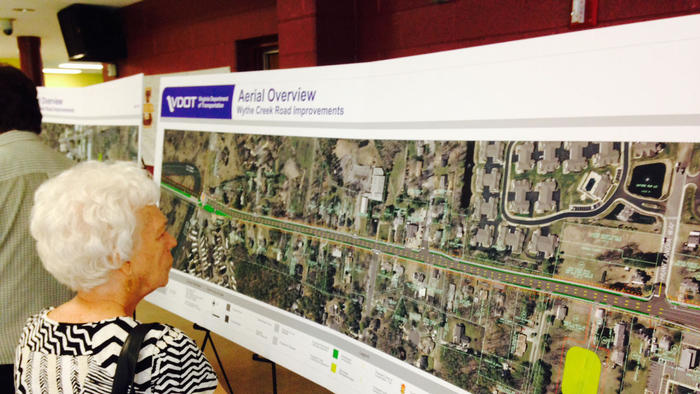
Poquoson and Hampton residents streamed into Poquoson High School’s cafeteria to view plans to widen Wythe Creek Road between Hampton and Poquoson. Photo by J. Elias O’Neal
The Virginia Department of Transportation laid out its plan Thursday during a public hearing at Poquoson High School to tackle chronic rush hour traffic congestion along a nearly 2-mile stretch of Wythe Creek Road — a thoroughfare thousands of Poquoson residents use daily to commute to NASA Langley, or to major employment centers in Hampton.
But instead of gobbling-up massive tracts of right-of-way to widen the road by four or five lanes, transportation officials have opted to use another method: reversible traffic lanes.
“About 70 percent of the traffic is going one way during rush hour,” said Mark Velasquez, VDOT senior project manager overseeing the $51.1 million roadway overhaul for the Hampton Roads District. “It is going southbound toward Hampton in the morning rush hour … and in the afternoon it’s going the other way.”
To get the nearly 16,000 vehicles that use the corridor daily moving faster, transportation officials believe having most of the traffic going in one direction during peak travel times is the key.
Wythe Creek Road would be widened to three lanes, starting at Langley Boulevard near NASA in Hampton.
The project calls for installing a middle lane that would be used during morning and evening rush hour travel times as an extra south or northbound lane to move vehicular traffic — all controlled with electronic signs that would change to alert drivers of the lane changes during the day. During non-peak rush hour times, the middle lane would be used as a turning lane.
Other improvements call for the causeway to be significantly elevated over the Northwest Branch of the Back River.
The current bridge is about 115-feet long, Velasquez said, but once the project is completed, the bridge will be lengthened to about 1,500-feet. The bridge will also be lifted about 10-feet higher than the current structure to ensure it never floods — giving Poquoson residents a three-lane contraflow option to evacuate when hurricanes threaten the area.
“It stretches over a causeway that floods pretty regularly,” Velasquez said. “For cases of emergency, there are only two ways out of Poquoson and you don’t one of the ways out flooded.”
The project would end near Huntlandia Road in Poquoson, and include curb and gutters, multi-path lanes for bikes and pedestrians on the west and east sides of the roadway, and new traffic signals at various intersections.
Despite a construction start date set for late 2018, or sometime during the first quarter of 2019, Velasquez said the project is already 97 percent funded. He said the remaining 3 percent will become available after the project’s completion in 2022.
Poquoson taxpayers will divvy-up $46,047 for the project, while the state plans to kick in about $2.9 million dollars. Hampton is not contributing a local match.
The behemoth of the project’s money will come from the feds, who have set aside roughly $46.6 million that will be distributed during phases of the project starting in fiscal year 2017.
Velasquez said transportation officials have already begun on the design work for the project, with officials looking to place the project out for bid by fall 2018.
Chris Cruz, a Poquoson resident and businessman who owns property at the intersection of Wythe Creek and Carys Chapel roads, said the project will have an impact on his property if the current plans remain permanent.
If the existing plans stick, Cruz said the widening could wipe out a storm retention pond that sits south of a professional office building he owns and operates his business in, as well as taking part of his parking lot.
But Cruz said he’s willing to compromise with VDOT, who has set aside $9.1 million for right-of-way acquisition, regarding the how the project could impact his property and business.
“The resident side of me likes it,” Cruz said. “The business side of me … nothing gives me a heart attack, but there are still some issues somebody has got to figure out.”

