
DAILY PRESS, July 8, 2015: A Wednesday technical glitch that suspended trading on the New York Stock Exchange (NYSE) had minimal effects on local companies that trade and sell shares daily on the global exchange.
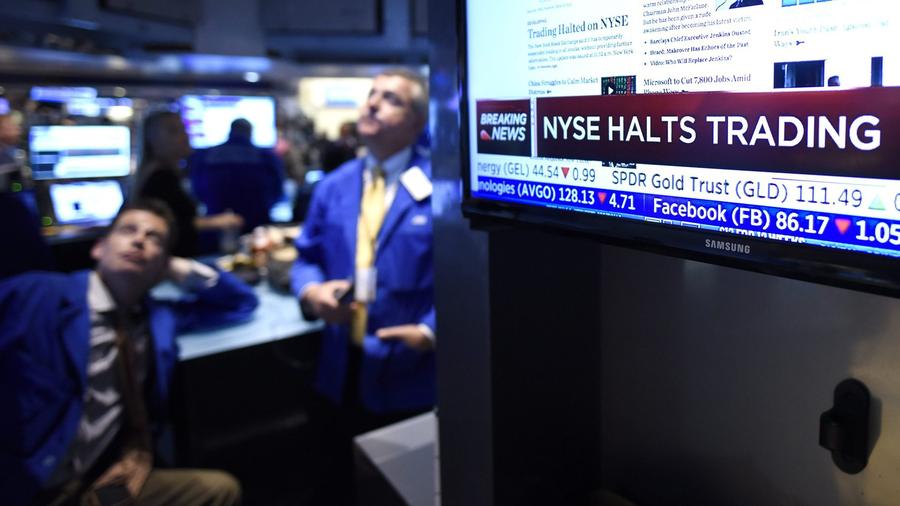
The NYSE came to a halt in July, but its stoppage had very little impact on Peninsula area companies. Photo by the Associated Press
“It really wasn’t that big of a deal,” said Andrew Cohen, a finance instructor and manager of the Gregory A. Lumsden Trading Room and Research Lab at Old Dominion University’s Strome College of Business. “The New York Stock Exchange is one of 11 exchanges, and one of 50 private venues where stocks trade hands.”
A number of Hampton Roads firms, including many located on the Peninsula, have stock traded on the NYSE.
Newport News-based Huntington Ingalls Industries (NYSE:HII), the firm that owns and operates Newport News Shipbuilding, is traded on the NYSE; along with Toano-based Lumber Liquidators (NYSE:LL).
Huntington Ingalls and Lumber Liquidators were trading at losses prior to NYSE suspending trading, with Huntington Ingalls at 112.28 a share and Lumber Liquidators at 20.18.
Jerri Fuller Dickseski, Huntington Ingalls Industries spokeswoman, said stock operations were not affected by the trading suspension.
“We continued to be traded in other markets,” Dickseski said.
Lumber Liquidators did not want to comment on any effects the suspended trading had on the firm, according to company spokesman John Feld.
Shares of Newport News-based Ferguson Enterprises, which is owned by United Kingdom-based Wolseley plc, are traded on the London Stock Exchange (LSE). Smithfield-based Smithfield Foods, owned and operated by China-based WH Group, trades its shares on the Hong Kong Stock Exchange (SEHK).
United Airlines blames grounding of hundreds of flights on computer glitch
United Airlines blames grounding of hundreds of flights on computer glitch
Neither are publically traded on the NYSE, and were not affected by the suspended trading.
Trading exchanges have struggled with technical troubles in recent years.
In May 2010, Cohen said, the Dow Jones industrial average plunged hundreds of points in minutes due to mass selling triggered by computerized trading programs.
But things have changed — in part due to new software programs that allow brokers and companies to sell stock, Cohen said. He added more company cash flow has allowed firms and investors to move money quickly through the new trading platforms.
“The system is much better than five to 10 years ago,” Cohen said, adding that stocks listed on the NYSE were able to continue trading on other stock exchanges, such as Nasdaq.
“It had nothing to do with stocks going up or down,” Cohen said of the NYSE technical glitch.
Despite the NYSE losing nearly 200 points, Cohen said much of the loss can be attributed continued stock market turmoil in China, where share prices have loss about a third of their value since mid-June. He said U.S. markets continue to perform well, adding that the suspended trading had very little to do with Wednesday’s market loss.
“This was a little thing,” Cohen said. “No one should panic.”
 J. Elias O'Neal