
DAILY PRESS, July 14, 2015: Caked with mud and fresh concrete, Daniel Francis stood in the middle of a hollowed-out shell that seemed more like a mine shaft than the region’s newest tunnel connection.
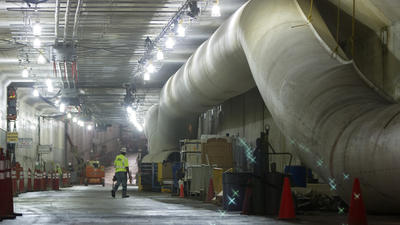
Crews place the final piece of the Midtown Tunnel into place in the Elizabeth river in Norfolk. Photo by Daily Press
As workers zipped and zoomed under the dim glow of lights in the humid haze, encapsulated by the concrete walls keeping the murky Elizabeth River at bay, Francis marveled at the structure that took nearly two years to construct.
“It’s very difficult,” Francis said of the new tunnel construction. “I have to remind myself that it’s a very good project to be on sometimes. Sometimes the day-to-day may get you down, but it’s a very exciting project.”
Early Tuesday morning, construction crew members installed the last of 11 tunnel segments needed to complete the new Midtown Tunnel. It’s a significant milestone, given that it’s been 23 years since the last time transportation crews completed a bridge-tunnel project — the Monitor Merrimac Memorial Bridge-Tunnel, which opened in in 1992.
Transportation officials hope to have the new tunnel, which is about six months ahead of schedule, open and operational by December 2016. The new two-lane tube will carry westbound traffic from Norfolk to Portsmouth; both lanes in the existing tube will carry vehicles east from Portsmouth to Norfolk.
The project, which was launched in 2013, is part of a massive $2.1 billion public/private venture between SKW Constructors, the Virginia Department of Transportation (VDOT), and the Elizabeth River Crossings OpCo LLC that will bring sweeping overhauls to the state’s aging, and congested, bridges and tunnels that connect Portsmouth and Norfolk.
The new tunnel will carry thousands of vehicles in the years to come, but on Tuesday morning, it was filled with the stench of sweat and river odors.
Francis, an SKW Contractors project manager, said getting the 11 segments to construct the tunnel took time and patience. They were built in a dry dock in Sparrows Point, Maryland, he said.
From Maryland, the segments were floated 220 miles down the Chesapeake Bay to Portsmouth, where they were stored at the Portsmouth Marine Terminal.
After dredging the river and preparing the foundation with sand, construction crews began submerging the nearly 16,000-pound structures into the Elizabeth River with a lay barge, which helps anchor the large pieces into the river. Once the segment is submerged, 30-inch diameter pipes are used to backfill the segments with about 675,000 tons of aggregate and soil before its topped off with 68,000 tons of large-diameter armor stone to protect the tunnel from passing ships.
On Tuesday, the construction site, with its bevy of loud cranes, barges and levies, appeared more like a Hollywood set for “Transformers” than the Norfolk shores of the Elizabeth River.
Industrial divers in wet suits moved about the 43-acre site with ease, occasionally stopping to take a break before immersing themselves amongst the twisted metal of heavy-duty machinery and river waters.
As morning gave way to the afternoon sun, workers had successfully put the last segment into place.
“Today is a very important milestone for us,” said Wade Watson, a project director with SKW Constructors, a joint venture of Sweden-based Skanska, Omaha, Neb.-based Kiewit, and Cranford, N.J.-based Weeks Marine that’s overseeing the expansion of the Midtown Tunnel between Norfolk and Portsmouth. “This completes the sectional elements for the new tunnel.”
Part of our history
Bridge-tunnels in this part of the country were contrived to keep people, war vessels and port cargo moving simultaneously, as post-World War II Hampton Roads blossomed.
Between 1952 and 1964, bridge-tunnel projects across the region would link cities like Hampton and Norfolk, that were, at the time, connected by water taxis and ferries.
Shortly after the opening of the Downtown and Midtown tunnels in 1952, state transportation crews began work on the Hampton Roads Bridge-Tunnel — a two-lane bridge-tunnel that opened in 1957, according to VDOT records.
It would take another 19 years — until 1976 — before a second, two-lane bridge-tunnel would be added to the HRBT, and 16 years more before crews would complete the Monitor-Merrimac connecting Newport News and Suffolk.
“It’s been more than 20 years since construction of the last major tunnel in the Hampton Roads area,” said Jim Long, major projects delivery director for the Virginia Department of Transportation’s Hampton Roads District. “Seeing this amazing feat of engineering take shape further motivates us to continue delivering more of these projects in the future.”
More will be needed as older thoroughfares like the Midtown Tunnel become outdated.
But given funding challenges at the federal, state and local levels, it could easily be another 23 years before Hampton Roads sees another new tunnel.

