Williamson County Sun, Oct. 11, 2009:
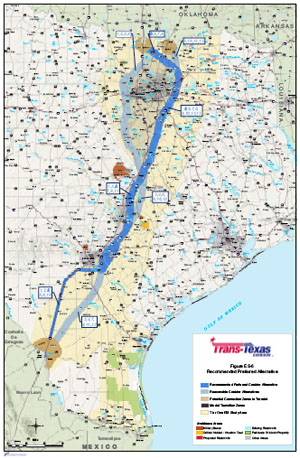
Proposed route of the TTC-35 project.
AUSTIN — Once considered Central Texas’ solution to increasing traffic congestion and growing cargo transports, the wildly unpopular Texas-Trans Corridor 35 project is officially dead, Texas Department of Transportation officials announced this week.
The transportation department, which spent years on large environmental study on a large swath of land stretching from Dallas to San Antonio, said last week it will officially recommend to the Federal Highway Administration that no action be taken on the massive road project.
Plans once called for Gov. Rick Perry’s brainchild to swallow more than 86,000 acres of farmland to accommodate lanes of freight rail, light rail and separate lanes for cars and large cargo trucks.
The project was estimated to cost more than $7 billion.
“I don’t think I have ever seen a no-build recommendation in a TxDOT environmental impact study,” said State Sen. John Carona, R-Dallas, chairman of the Senate Transportation Commission. “It says a lot about today’s transportation commission and their responsiveness to the public.”
Word of state transportation leaders shelving plans for the massive TTC-35 project was good news for members of the Eastern Central Texas Sub-Regional Planning Commission. The group composed of nearly 6,000 Williamson and Bell county residents, ranchers, farmers and business owners — including the mayors of Bartlett, Holland, Little River-Academy, Rogers and Buckholts — formed more than a year ago to stop what many ranchers and farmers called a boondoggle project.
“What was alarming about this project was the local impact it would have had on these communities,” said Executive Director Margaret Byfield with Taylor-based American Stewards of Liberty, which worked with the sub-regional planning group to oppose the development of TTC-35. “It seemed that TxDOT didn’t care about what effect this road might have on the blackland prairie, the school districts, emergency personnel or, most importantly, the people and farmers that called this area home.”
Commission President and Holland Mayor, Mae Smith, charged that TxDOT officials failed to conduct a proper environmental study on the true effects the highway would have on the region.
“If they did their work, which clearly they didn’t, they would have known that this project would have had a serious impact on our farmlands, and the already-endangered blackland prairie,” Smith said. “But that didn’t matter because, I feel, they wanted to get the highway built regardless; so we mobilized and fought back.”
Commission board member Ralph Snyder said the state’s use of eminent domain for the project was also a major issue for many farmers and ranchers throughout the region.
“These people have been on their land for four to five generations,” Snyder said. “If the state tells them that they’re going to give them $5,000 an acre, that would have caused problems. If this plan moved forward, I don’t think many would have given up their property without a fight.”
Commission members said while the fight to end the project is over, the war may be just beginning.
“We’ve been here before,” Snyder said. “Until the FHA officially says the project is dead, I think we’re going to be on guard for a while.”
Snyder is not alone in that theory.
Waco-based Texas Farm Bureau President Kenneth Dierschke said while he’s happy officials verbally killed the project, his concern is that the cancellation is a political stunt.
“It’s quite ironic that this announcement comes one day after the Farm Bureau endorsed [U.S.] Sen. Kay Bailey Hutchison in the governor’s race,” Dierschke said. “Until the legislature deals a final blow, we’ll reserve our judgment.”
Texas Farm Bureau officials endorsed Hutchison during a Fort Worth press conference last week, according to an Associated Press report.
Dierschke said historically Perry has received the bureau’s endorsement, but he said many group members lost faith in the governor and his support for private property rights. He members cite his veto of an eminent domain bill in 2006, and his support of Trans-Texas Corridor project, which would have devoured ranch and farm land across the state.
“This is not the first time TxDOT has said they killed the TTC,” said Hutchinson’s Deputy of Communications Director Joe Pounder. “The Texas-Trans Corridor will not be officially dead until Rick Perry is no longer governor, and his political appointees are no longer running TxDOT. Texans can’t trust Rick Perry when it comes to protecting their land from the government.”
Calls to Perry’s office were not returned by press time Friday afternoon.
State Rep. Dan Gattis, R-Georgetown, said he’s quite confident the TTC-35 project will not come back to fruition.
Gattis, a long-time opponent of the project because of its potential impact to the eastern half of his district, said it would be extremely difficult to restart the project.
“We’re talking about having to restart the entire process over again; from meetings to environmental studies,” Gattis said. “I just don’t see that happening again for this project. The legislature has fought long and hard against this, and the people have spoken.”
State Rep. Diana Maldonado, D-Round Rock, agreed.
“TxDOT’s announcement to effectively kill the Trans-Texas Corridor is a huge win for Texas landowners and taxpayers,” Maldonado said. “While we have critical transportation infrastructure needs, especially right here in Williamson County, I believe we must find solutions that do not include using Texans’ tax dollars to subsidize toll roads.”
Smith said while the group is happy with their work to override the corridor project, she and other “fighting farmers” will remain cautiously optimistic.
“It’s not over yet,” Smith said. “You can rest assured of that.”
 J. Elias O'Neal